
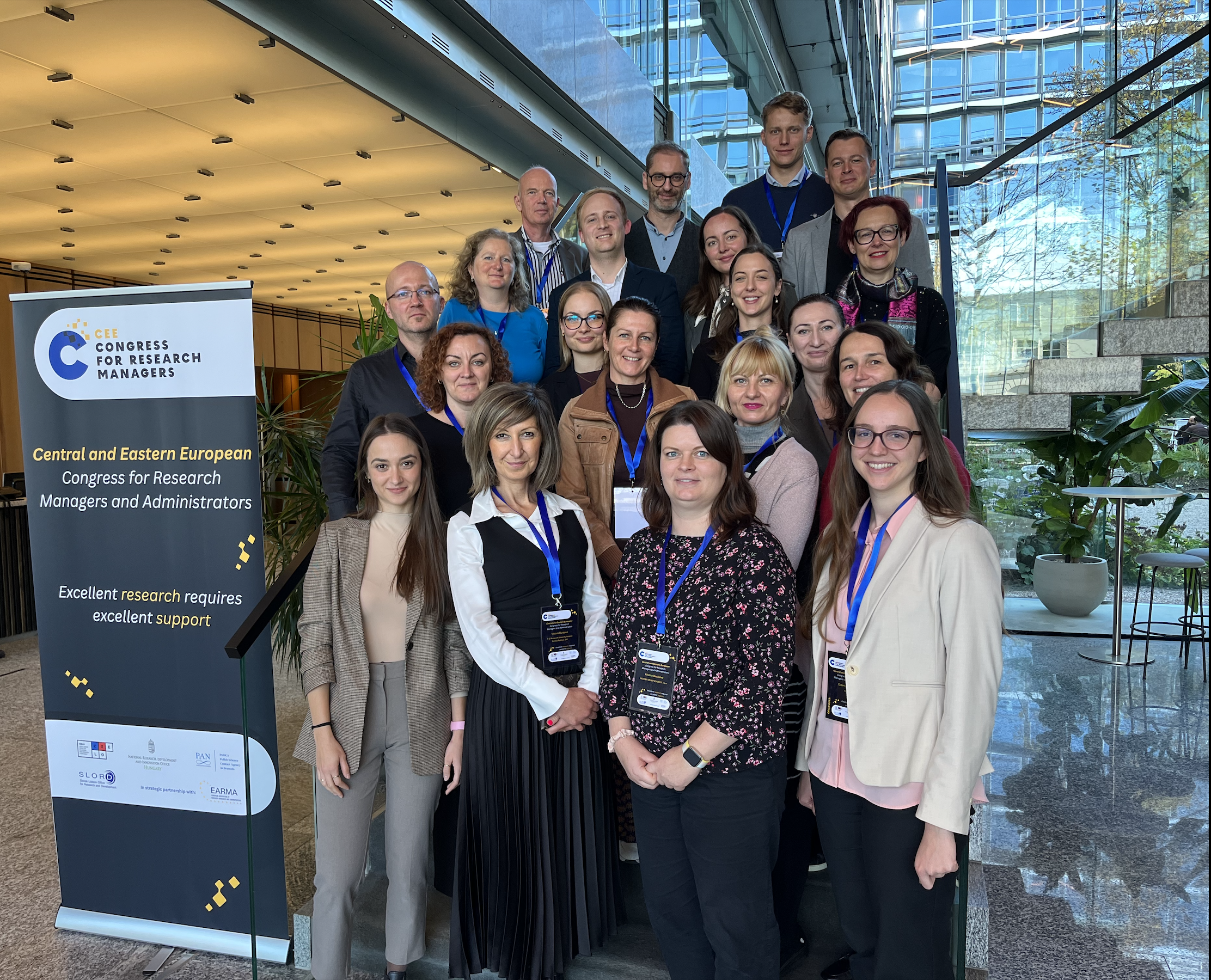
Research project managers from thirteen Slovak research and innovation institutions took part in the first-ever Congress for Research Managers and Administrators of Central and Eastern Europe, held in Brussels.
Representatives of research institutions and universities from across Central and Eastern Europe gathered in Brussels on 4–5 November 2025 for the first-ever Congress for Research Managers and Administrators. The two-day event brought together more than sixty experts in research management from eleven countries, aiming to strengthen collaboration, share experience, and support the professional development of research management in the region.
The event was co-organised in partnership with Czechia (CZELO), Hungary (NRDIO), and Poland (PolSCA) while the European Association of Research Managers and Administrators (EARMA) acted as a strategic partner of the Congress.
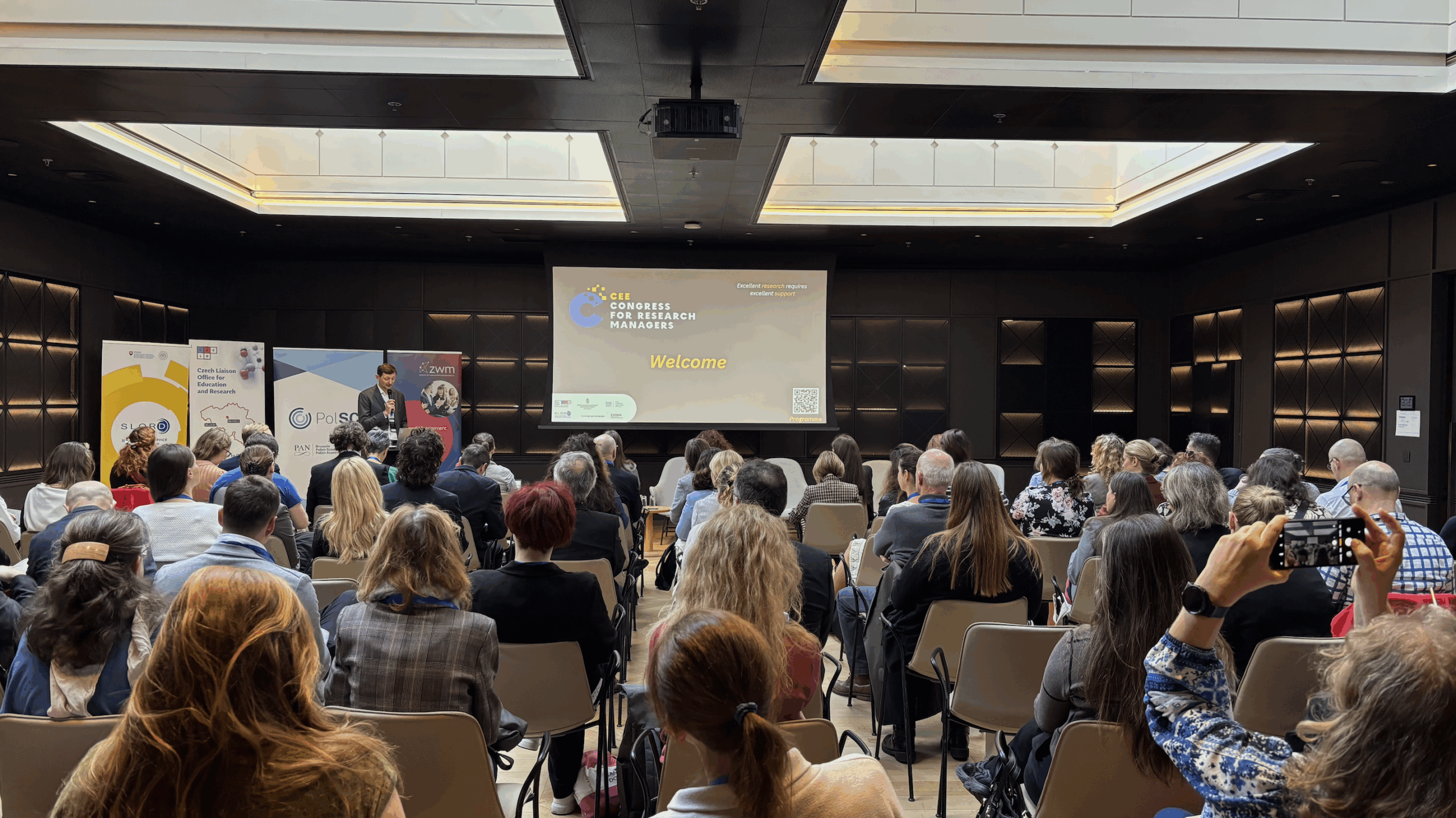
Building Excellence in Research Management
The Congress was opened by Virág Zsár, Research Director at the Hétfa Research Institute, who in her keynote address underlined the growing importance of research managers as key actors driving institutional performance, innovation, and international collaboration. Her message was followed by a panel discussion on developing research potential in the Central and Eastern European region, moderated by Henning Rickelt from the German Centre for Science and Research Management. During the discussion, Anna Seip from the European Commission presented the Commission’s strategic perspective on capacity building and the professionalisation of research management.
From Slovakia, Peter Cuninka of the Slovak University of Technology in Bratislava shared national experiences in establishing research support structures at the university level and in advocating for recognition of the profession’s importance. Lenka Chvojková represented the Technology Centre Prague and the well-established CZARMA network, while Ewa Mendec from the Silesian University of Technology and the newly founded PolARMA shared the Polish perspective. The Hungarian experience, from the viewpoint of a funding organisation, was presented by Dóra Pivarcsiné Fekete from the National Research, Development and Innovation Office.
At the heart of the Congress were a series of practical and interactive workshops focused on talent development, successful project proposal design, effective financial management and planning, and the use of digital tools in research management. The sessions, led by experts Jiří Sýkora, Judit Fekete, Toni Skeen, David Kurz, Simon Cullen, and Miguel García González, created valuable opportunities for exchanging experience and strengthening international cooperation in the research community.
Expertise, Collaboration, and Modern Technologies in Research
The second day of the Congress built on the workshop series and opened with a session led by Dagmar Vokounová Franzeová from the University of West Bohemia in Pilsen, focusing on developing soft skills in research management. Joanna Bosiacka-Kniat from the Poznań Science and Technology Park presented best practices in financial planning and budgeting, while David Kurz from the European Research Council discussed impact assessment methods and communication with funding agencies.
Edwin Kanters, Director for Research and Innovation at Utrecht University, used the metaphor of research managers as mythical unicorns to highlight their indispensable role as professionals who bridge strategy and practice, enabling the creation of innovative and sustainable projects.
The theme continued in a roundtable discussion on cross-border collaboration, moderated by Teodora Konach from EARMA. Panelists included Linda Kapustová Helbichová from the International Visegrad Fund, who presented new opportunities for funding collaboration; Jacek Kuźnicki, who built the successful International Institute of Molecular and Cell Biology in Warsaw on the strength of outstanding research managers; and Edwin Kanters, who contributed insights from Utrecht University’s experience with new approaches to measuring research excellence and impact.
An afternoon panel discussion on the use of artificial intelligence in research, moderated by Lars de Nul from the European Commission’s Directorate for Artificial Intelligence in Science and Technology, offered participants concrete examples of AI tools in academic settings. Contributions came from Kristjan Zemljic of Global Disruption, Tomasz Parkoła of the Poznań Supercomputing and Networking Center, and Gergely Szertics from the Hungarian Research Network (HUN-REN).
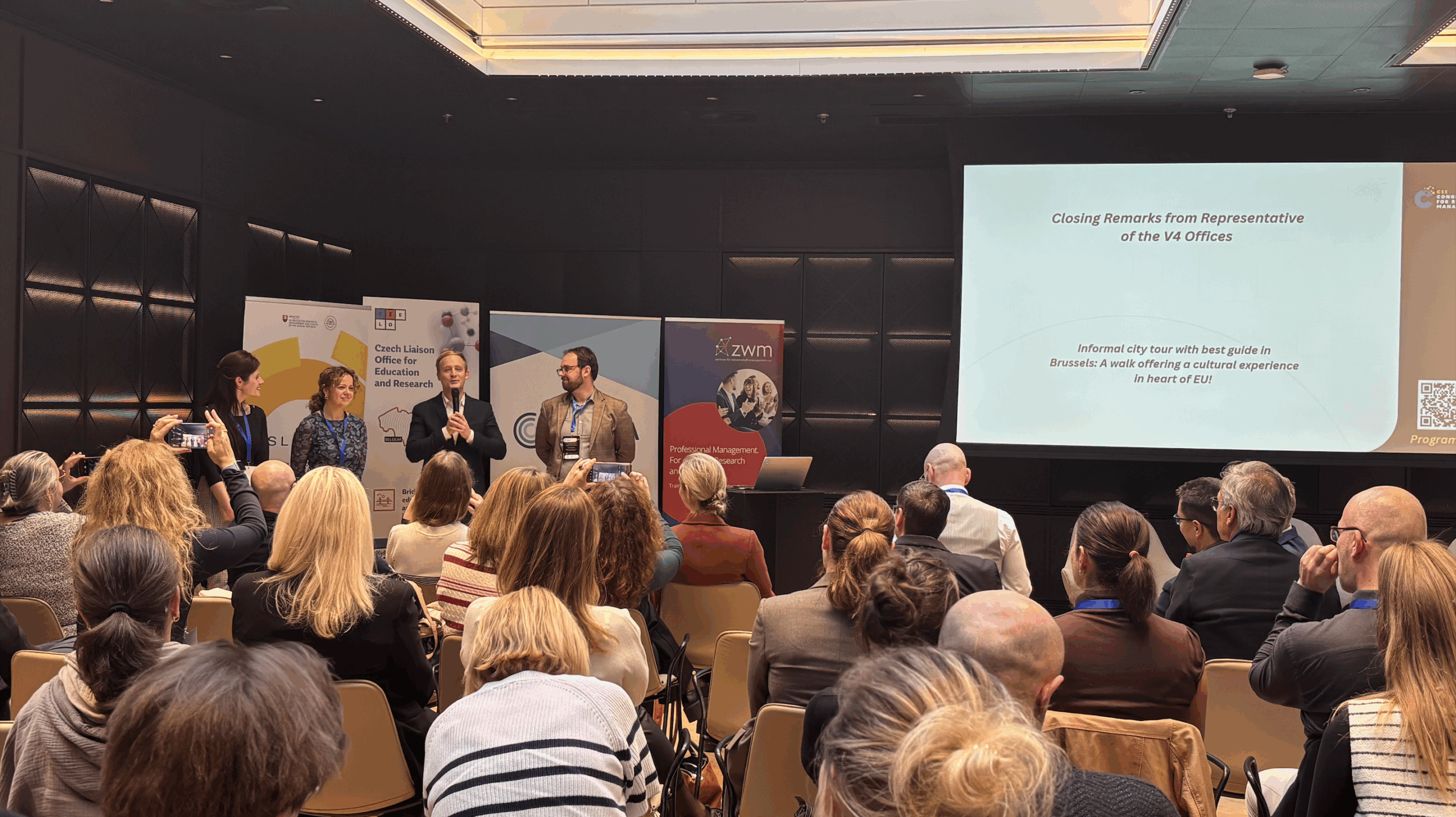
The Congress concluded with a keynote by Nik Claesen, Executive Director of EARMA, who presented the vision for further development of the research management profession. He emphasised the need for building stable support structures, continuous professional education, and stronger integration of the profession within the European Research Area.
Strong Slovak Representation
Thirteen participants from Slovakia represented academic, research, and industrial institutions, including:
- Centre for Quantum Technologies Research
- F. D. Roosevelt University Hospital Banská Bystrica
- Medirex Group Academy, n.o.
- SEC Technologies, a.s.
- Slovak Academy of Sciences
- Slovak Battery Alliance
- Slovak University of Technology in Bratislava
- Technical University of Košice
- Comenius University in Bratislava
- Pavol Jozef Šafárik University in Košice
- VUJE, a.s.
Their participation demonstrates that the Slovak community of research managers actively contributes to strengthening the position of Central and Eastern Europe within the broader European Research Area. The event created a platform for discussing a shared vision for developing the research management profession, exchanging experience, and connecting universities, research organisations, and national agencies.
Published 07.11.2025, slord