

Source: European Union
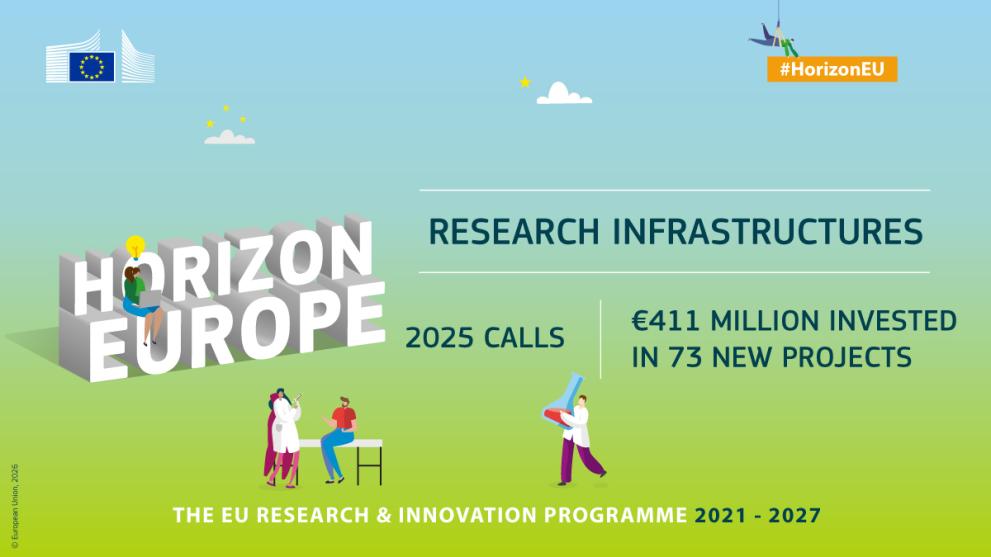
Through the European Research Executive Agency (REA), the European Commission has allocated €411 million to 73 new projects under the Horizon Europe Research Infrastructures 2025 call. The supported projects aim to provide researchers and innovators with access to higher-quality technologies, services and tools while also strengthening the European research infrastructure system. The projects cover areas ranging from health research and climate resilience to agriculture, transport, manufacturing and digital technologies.
The call was divided into four main areas:
- INFRADEV supported 30 projects with a budget of €109 million,
- INFRAEOSC includes 13 projects with a budget of €85 million,
- INFRASERV includes 12 projects with €154 million,
- INFRATECH includes 18 projects with a budget of €63 million.
In total, 73 projects were supported out of 159 submitted proposals.
Focus on open data, artificial intelligence and sustainability
A significant proportion of the supported projects responds to the need to modernise European research infrastructure and strengthen its links with digital technologies. Projects under INFRAEOSC, for example, will focus on the European Open Science Cloud (EOSC) readiness for artificial intelligence, the management of research data and their findability, accessibility, interoperability and reusability.
Another priority is reducing the environmental footprint of research infrastructures. Projects under INFRATECH will, among other things, use artificial intelligence, digital twins and advanced simulation tools in areas such as climate modelling, healthcare, transport, agriculture and manufacturing.
Slovak participation in new projects
Several supported projects also involve Slovak research organisations. These include projects focusing on artificial intelligence and EOSC, the sustainability of digital research infrastructures, biomedical research and the modernisation of accelerator technologies.
The Institute of Informatics of the Slovak Academy of Sciences (SAS) is involved in four projects:
- ENSURE – ENvironmentally SUstainable digital services and practices for REsearch infrastructures focuses on reducing the environmental footprint of digital research infrastructures. The project uses environmental indicators, monitoring tools, digital twins of data centres and generative artificial intelligence methods. The project also includes the implementation of the “Measure, Model, Monitor, Moderate” cycle, which aims to support the systematic measurement and reduction of environmental impacts.
- FLUID-AI – FAIR Liquidity Unifying Interoperable Data and AI focuses on connecting research data, artificial intelligence models and digital solutions within EOSC. The project develops the concept of Data and Models Liquidity and aims to create tools supporting the interoperability and reusability of data and models, as well as the development of skills needed to use AI in research. In addition to the Institute of Informatics of the SAS, Slovak University of Technology in Bratislava is also involved in the project.
- GenAI4Earth – Generative Artificial Intelligence for Earth System uses trustworthy generative artificial intelligence to support research on the Earth, climate, the environment and interactions between ecosystems and human society. The project works with data from satellite and ground-based observations, models, experiments and text-based sources and plans pilot applications, for example in urban resilience, agro-environmental monitoring and seismology.
- EOSC-ARENA – AI Research Enhancement through Networked Agents creates an environment for generative and agentic artificial intelligence integrated into EOSC. Its aim is to support researchers throughout the entire research cycle, from searching the scientific literature and formulating hypotheses to analysis, publication of results and recording data provenance. In addition to the Institute of Informatics of Slovak Academy of Sciences, Slovak participation is also ensured by Slovak University of Technology in Bratislava.
Slovak partners are also involved in other areas of research infrastructures. The Institute of Electrical Engineering of the SAS is a partner in the EPITA – Enabling Partnerships for Innovation & Accelerator Technology Advancement project, which will support the development of new technologies for European particle accelerators. The project envisages the creation of 22 prototypes in the areas of accelerator systems, magnets, particle beams, and advanced technologies and materials.
The Institute of Chemistry of the SAS is part of the MIRRI-FIRM – Making MIRRI FAIR for Globally Impactful Research project. The project builds on the MIRRI-ERIC infrastructure and will focus on improving the accessibility, quality and sustainability of microbial resources and related data. An important component will be aligning them with the FAIR principles (Findable, Accessible, Interoperable, Reusable), developing a catalogue of microbial resources and strengthening links with EOSC.
Slovak representation is also present in ECRIN 2030 – European Clinical Research Infrastructure Network 2030, which involves Pavol Jozef Šafárik University in Košice. The project focuses on developing infrastructure for clinical research in connection with the European Health Data Space, new forms of clinical trials and expanding links between European capacities in the field of clinical research. The project is planned to run from June 2026 to May 2029.
Strengthening the European Research Area
The new projects thus link the development of research infrastructures with the European Union’s priorities in the areas of open science, digitalisation, artificial intelligence, the green transition and health research. They will also support training, mobility and the career development of researchers and other professionals working in the field of research infrastructures.
The supported projects are already starting their implementation, and their results are expected to contribute to the development of the European Research Area, as well as to Mission Cancer and Destination Earth (DestinE) initiatives and to achieving the objectives of the green and digital transitions.
Published on 24 September 2026, slord